The Story
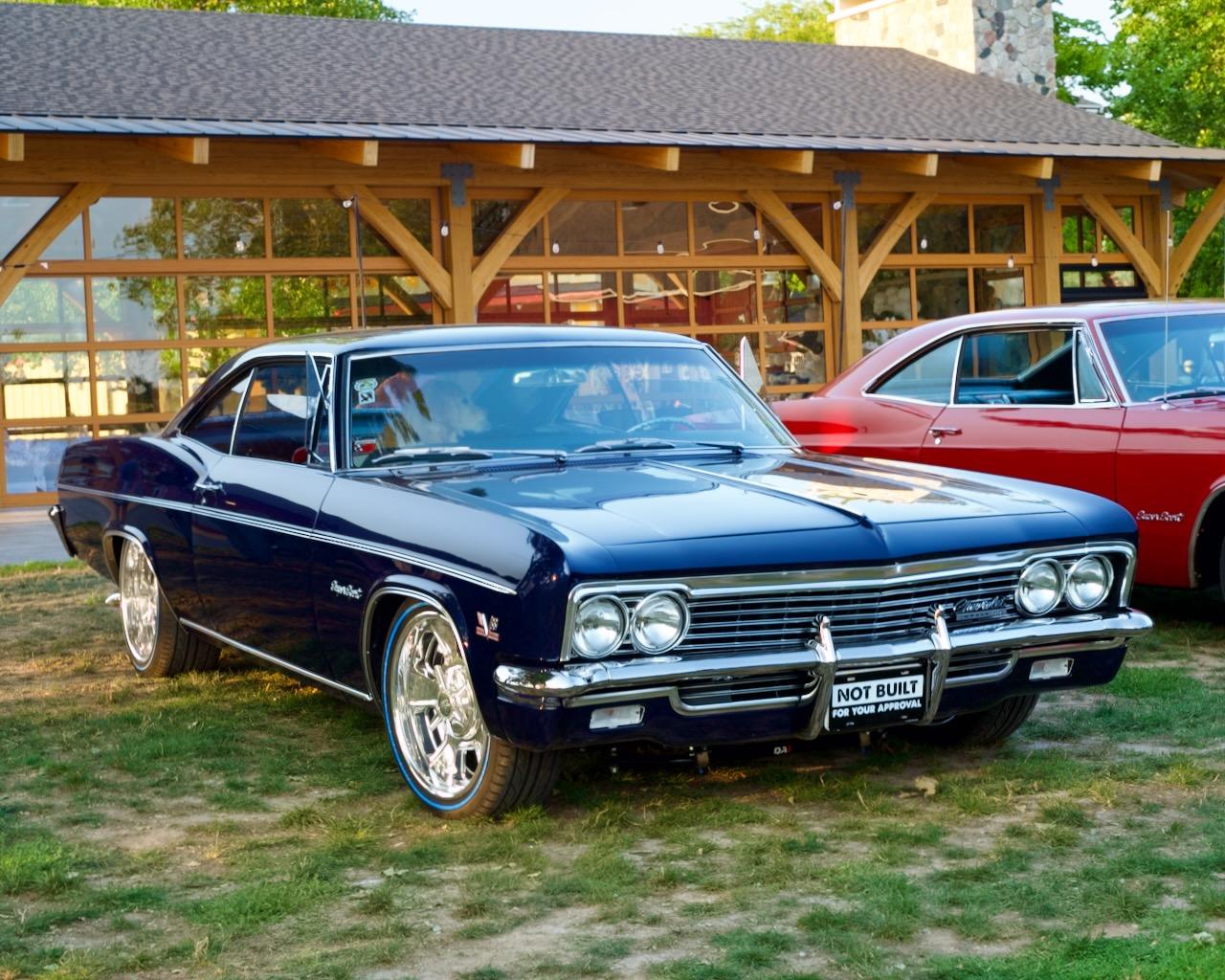
I was fifteen when I bought my first car, a 1965 Impala. Evening Orchid in color; my friends called it the “purple zit.” But it had a factory big block 396 and four speed. I bought that car from the same man I bought this ‘66 Impala SS from over nearly 40 years later.
He’d purchased the car 26 years before he reluctantly sold it to me. He drove it back from AZ and parked it in a corner of his body shop where it sat all those years. He rarely parted with classics he collected but his favorites were 1949-1951 Mercurys.
He never told me why my car found its way into his hands. Mine truly was special. A rare, 427 (L72 code) 4-speed car made more rare by the fact that it was also one of only two known, factory 2 tone paint codes with 427, 4-speed drive train combination. Danube Blue roof color and Mist Blue lower.
Everyone wanted this car. He listened to hundreds of offers but he accepted none. His son wanted the car in the worst way because my friend was building an identical car for his grandson. It was another 427, 4-speed car but not the 2 tone paint code. Every time he found NOS parts for the grandsons car, he bought the same for my car.
My friend was a Vietnam Veteran suffering from PTSD, depression, complications of Agent Orange. I am an Iraq and Afghanistan Veteran also troubled by PTSD and depression, amongst other health issues. The car became our therapy.
Over the course of a year we completely disassembled the car. I did all the work while my friend assumed the role of supervisor. The car was down to a bare frame and at the powder coater, the engine a bare block, when tragedy struck. My friend died. I was gutted by the loss and the reality that I now had a car in 1000 pieces, and no idea how to continue.
Over the course of several months I moved the entire project 500 miles down to my home in MO and began looking for someone to help me continue the build. I made dozens of calls, talked to hundreds of people at car shows and cruise-ins, and pursued referral after referral. Nobody wanted anything to do with “someone else’s problem project.”
At the end of any remaining hope I finally found “The Guy” after 6 months of searching. The work in his shop was impeccable, certainly on the order of my deceased friend, arguably better. He was only 30 minutes from me, he said I could help as much or as little as I wanted, and I could afford him. A trifecta win in my book. The only problem was he had a year long wait list. I offered a deposit to assure him I was serious but he wouldn’t take; another good sign. He put my name on the list.
While I waited to resume the build, I located a speed shop that would put new life into the motor. The owner worked for Rausch Racing for many years so I knew things were in good hands. I only needed to tell him what I wanted and he was off to the races, so to speak.
A year later, the motor produced respectable numbers on the dyno at 500 HP and 515 lb/ft torque after receiving a mild cam, bigger valves, ported and polished heads and air gapped intake, 650 Holley, long tube headers, and a few other goodies. It also has a March serpentine belt system on the front end.
Now three years from when the project began, I moved parts into the builders shop. I coordinated with him to purchase long lead items so the build wouldn’t be held up waiting for parts. We did have a lot of extra NOS parts but my grand plan was to make the car much safer and a better driver than when it left the assembly line. So many of the purchases were after market parts.
A Tremec TKX five-speed now sits behind the motor and transfers the HP to the 12 bolt, posi, 3:31 rebuilt rear end. There's a QA1 level-2 suspension with coil over shocks on all four corners. Six piston Wilwood brakes on the front and 4 piston on the rear clamp down on slotted discs. Everything runs on 19” front, 20” rear Billet wheels with blue stripe tires supplied by Diamondback.
The interior is a completely stock, two tone, save the Vintage Air a/c ducts and the shift arm and ball. It sports optional 4 gauge console cluster, padded lower dash, factory tach, and most notably, an extremely rare, tilt/telescopic steering column. 1966 was the only year that Chevrolet had them as an option and only 1700+ got them of the 1,500,000 full size cars produced that year. The nearly impossible to find horn cap was a gift from a fellow club member and served as the crown jewel of the build, the last piece to be snapped into place 5 years from when the first part was disassembled.